Showing posts sorted by relevance for query "Part I". Sort by date Show all posts

Friday, April 24, 2009

On Stoles, Part I: Stoles Were Worn

Hey folks! I is back! I took a couple days off this week to recharge my batteries. Felt bad about it at first but then I realized no one's ever commented that I don't weave or post enough whereas some folks have told me to cut back on the ol' intertubes, so hopefully no one will have minded too terribly much. :) Although I haven't been blogging, I have been working away on the stole.


So. This stole. As I mentioned a while back, a friend of the family is being ordained as a priest in a little while - in two weeks, in fact!1 My in-laws wanted to give him a gift to commemorate this major event in his life and my mother in law thought that a handwoven stole to wear with his vestments would be just the thing. Olive and I spent a couple weeks looking for sources of inspiration - she sent me tons of pictures and videos from church events she'd been to at which Stoles Were Worn2 and I trolled the 'net looking for other handwoven stoles to get some specifics re: an appropriate width, length, material, pattern, etc.

By using Google Image Search, I found a handful of web sites that offer handwoven priest stoles for sale, including this one, this one and this one. The first one, Maryweave Studio, is my favourite and the one I kept going back to over and over 'cause I absolutely loved the colours. Really, if I were buying a stole for someone, it's where I'd head.

As a result, I started thinking of something far more colourful that the stoles that Olive had sent me pictures of. I even started wondering if some of the scarves I had woven would work - in different dimensions, of course, but the colour combos might do. To test this theory, I dressed Ron up in a blanket and threw scarves around his neck. Have I mentioned how obliging and supportive my husband is? Add long suffering and pious to the list as well!

I offer you Exhibit A in the "Your Husband is a Saint" category:


Really looks the part, don't he? The whole dress-your-husband-as-a-priest angle is pretty hilarious on its own but it totally cracks me up to see how his facial expression changes as the process went on. The first time I threw the blanket over him and told him where to stand, he thought it was funny. The second time, he understood why it was necessary. The third time? The third time he thought I was nuts. And irritating. But he did it anyway. That qualifies him for sainthood in my book.

Incidentally, when I showed those pictures to Olive her first reaction was: "He looks so holy! You know, I always hoped he'd become a priest..." She was laughing but absolutely serious. How is a daughter in law supposed to respond to that? "Gosh, I'm... sorry?"

So anyway, back to stole development. Olive and Vic (the other half of the dastardly in-law duo) came over one evening to Talk Stoles. They had a look at the scarves and Olive and I talked length, width and weight of the fabric. Olive really wanted to go with a wine red, though she was tempted by one of the blue scarves. In the end, however, they decided to go with a more traditional colour scheme: a white stole with gold edges. Olive was hopeful that I could put a cross or something on it, a la Jackie's beautiful stole, but I really didn't want to get into pick up or finger manipulated weaves.3

So after O&V left, I started playing with Fibreworks to design a draft. I didn't want to do a finger manipulated weave but I was fine with doing something other than plain weave and eventually settled on an 8 shaft 2/2/2/1/1 twill:


Is that a "fancy twill"? Not sure. I came up with it just by slapping in a point threading and treadling and then playing around in the tie up until I liked the alternating diamond blocks. I really liked those horizontal bands on the stoles from Maryweaves, like this one for instance, so I put some of those in and I snuck a little of Olive's wine red in to set off the gold bands at the edges.

I tried to get clever with Fibreworks by repeating the whole stole treadling twice and then fiddling the printed EPI so that the two halves showed up on the page side by side. This made them Very Tiny and distorted the diamonds considerably but it did give me an idea of what the finished beastie will look like:

So! That's covers the first couple weeks of this project: gathering ideas, playing Mr. Dressup with Ron, and finally settling on a draft. At this point I had a plan I was happy with, so I ordered my yarn and waited for it to arrive.

Next up: the yarn arrives, the draft is tweaked and the warp is wound!


1. Two weeks should be plenty of time to break in a new co-op student starting Monday, clean up the yarn room enough to turn it into a guest room, take a 3 day mini-break to Halifax to pick up Mom, start getting the shop arranged and receive dropped off product from consignors, weave the stole fabric, then cut it up and assemble it into the finished, mitred, and lined stole. Right? Right!

2. Yes, believe it or not, she regularly whips out her digital camera and tapes stuff at church, right during the service! Baptisms, ordinations, even Easter Vigil. She gets away with this because she is 80 years old and barely over 5 feet tall, so no one has the heart to take her camera away. ;)

3. See 1.

Friday, April 3, 2009

A family affair... [Guest Scarf #5]


Not long after I posted a request for guest scarves on the shiny new WeaveZine forums,1 Christopher Netter wrote me about a scarf that he'd made: "Well, it's not exactly new (last year), but here's some pictures and text via my wife's blog posts on one of the scarves that I was weaving last summer. The scarf uses rayon yarn in both the weft and the hand painted warp. The weave structure uses a progressive twill that I whipped up on the computer. "

So I moseyed off to Cheryl's blog to see what Chris was talking about and... WOW! No wonder the scarf sold so quickly after they listed it in their Etsy shop.


Needless to say, these three little sentences and the pictures of their beautiful scarf on Cheryl's blog2 prompted more questions than they answered, so I just had to find out tons more about this project! Turns out that Chris' wife Cheryl dyed the warp for the scarves - three, not just one - and that Chris wove each one with a different weft and treadling.

In contrast to the first few guest scarf posts for which weavers wrote up a little story that I could post as a single piece, this scarfa story unfolded via some back and forth emails in which I'd ask a bunch of questions and Chris would answer them. Since I'd much rather post the guest scarfas in the weaver's own words rather than mine, I'm going to try a sort of "interview" format this week. Incidentally, some of the conversation was more about selling scarves online than about Chris and Cheryl's gorgeous scarves themselves but, since this is a topic that's been on my mind a lot lately and I know at least a few others' as well, I've left it all in.


Chris writes:
"We are both embedded software engineers by training, although Cheryl is now retired and is spending more time with her life long past-time of fabric based soft-sculptures. These employ hand dyed fabrics, hand painted faces and other feature, beading, clothing, and well, everything else that would go into a soft sculpture. Cheryl's love of color and skill with dying was the motivating force behind the scarfs.

I began my fascination with fiber at an early age with braiding, a pastime I still practice -- on Cheryl's hair. I began weaving 14 years ago, because it looked like fun and it involved "patterns" and fiber. That, and I've always found looms facinating. I love twills in all their varieties and took the Cheryl's dyed warps and created drafts and threading that showed them off to their best advantage.


This is what happens when a "pattern person" gets carried away. This scarf is woven using a progressing twill pattern on a purple and turquoise hand-dyed warp with a black weft. The result: an eye catching scarf with a wonderfully soft hand. It measures 7 1/2 inches wide by 45 inches long with an additional 3 inch twisted fringe.


JWD: What a beautiful scarf!


CN: Thanks!

JWD: And congrats on the quick turn around on Etsy. I really love the dolls you two have in your Etsy shop as well - verrrry tempted by the ogre and wyvern in particular.

CN: Don't be bashful. They're up there for YOU to buy.

JWD: I've always been curious how well handwoven scarves and shawls sell on Etsy. Do you find that your things move pretty quickly in general? I've got an Etsy seller account and one on Artfire as well but since I've never uploaded any pics to either one yet, I haven't made any grand discoveries. ;)

CN: My wife runs the Etsy shop (I think she also has one on Artfire as well). We've put three scarves up (the three from the same warp) and two "flew out the door" - to the same person. The third has a magenta weft and is still up for sale. So I'm not sure that I've got the best set of data for how well scarves and such sell on Etsy.

JWD: Is a "progressive twill" the same thing as an "advancing twill"?

CN: Yah, same thing. I tend to think of the twill progressing while I'm weaving, hence my "twisted" terminology. To be honest I think that only one of the three qualifies as "advancing". In looking over the drafts just now, only the black wefted scarf's twill advances. The navy weft is "just a twill" and the magenta weft I believe would be a "point twill".

JWD: How did Cheryl dye the yarns? It looks like ikat...?

CN: The warp was hand-painted using fiber reactive dyes. Fundementally, the warp is laid out then dyes are applied in sections and allowed to overlap to blend the colors. There are actually two different hand-painted warps in each scarf. That and a change in twill direction is how the striping was achieved


JWD: What weight of rayon did you use?

CN: 8/2

JWD: What EPI?

CN: 18 EPI - balanced

JWD: Is the weft the same as the warp?

CN: Yes the same 8/2 rayon yarn that was used for the weft and warp. The warp started life as white, but once it was in Cheryl's hands it became more colorful.

JWD: What software do you use for designing?

CN: BeforeWeaving.

JWD: Cheryl's blog mentions that there were three scarves on the warp - did you use the same treadling for all of them? The same black weft?

CN: There were three scarfs on the warp and the tie-up is the same on all three, but the treadling pattern is wildly different. Here's some commentary on each.


Navy weft: This is a "simple twill" - I was letting the twill and the color shift warp bring out the striping in the scarf. This result is a nice even hand and smooth fabric. About as 'classic' as I was going to get out of this threading and tie-up.


Black weft: This is what happens when a 'pattern person' runs amok with weaving software. The treadling shifts each iteration, creating the advancing twill (the draft is almost visually disturbing when viewed on the software). The resulting fabric is thicker and softer than its twill sibling. (It also has some floats that are almost too long.)


Magenta weft: I was playing with a point twill design here and letting the patterns in each stripe mirror the adjacent stripe. It looked really cool on the software. It looks REALLY PINK with the magenta weft.3

JWD: Were they all the same length?

CN: Well, they were suppose to be the same length, but I miscounted the marker threads on the black wefted one and it ended up 45 inches. I've since changed my measuring approach. Now I pin an old tape measure at the beginning of each item and weave until I get to the desired length. No muss, no fuss, no counting.

JWD: Speaking of length, do you usually weave your scarves to finish around 45" long? I'm still trying to gather intel on the length that folks like to weave their scarves. :)

CN: I aim for a something in the mid-50's. Truth be told, I'm terrible at estimating finished length. This is in part due to the utter laziness and in part due to um, not needing to know. Funny thing is, I'm an engineer by day - you'd think that I'd be all neurotic about that sort of thing.


Aren't they all beautiful? I can't decide which I like best! I think it might be the blue one but I'm all about bright colours these days and I'm really loving that pink one. Parenthetically, all of these scarves as well as many of the wearables in Cheryl's Etsy shop are modeled by their daughter, so the whole family really is involved. Lucky them to have such a beautiful and obliging model for their products! Very good planning on their part, I must say. ;)

You can see more pictures of Chris and Cheryl's work on a website Cheryl put together a few years ago, so be sure to do that... but first, if you are even the tiniest bit like me, you MUST stop reading Right Now and go to see Cheryl's Etsy shop. Come back after, please, but stop messing about and Go Look. Right now. Go on.

...Back? Good! Aren't those amazing? For anyone who might be interested in such information,4 the following items are now officially on my birthday wish list: the aforementioned ogre which is just too fab for words, this kitty fairy I'm not sure I can live without much longer, the ridiculously cool dragon pendant, the very cute kitty potholders, or any of the kitty (or fish) pins. You've still got a month, so there ought to be plenty of time. ;)

See you Monday!


1. If you haven't been to the revised WeaveZine site yet, hie thee hence and check it out! It's the old WeaveZine (now in weekly format!), WeaveCast and WeaveGeek sites all rolled into one.

2. Can I just say right now that "Twentypoundtabby" is quite possibly the best blog name EVAR? Scampy, our own nearly-twenty pound calico would be really cheesed if she knew about it - at me for not thinking of it first, and at Chris and Cheryl's cat for outranking her in the blogosphere. Scampy is Alpha Cat around here and likes to throw her considerable weight around if she thinks her position as high cat on the totem pole is under threat.

3. If you ask me, it looks REALLY COOL in the scarf, too!


4. *cough*Ron*cough*Mom*cough*

Monday, October 19, 2009

Sheds, temples and water lilies

Just a quickie to show you guys some of my progress so far on Craft Market Countdown 2009. You may have spotted my tally in the top right corner; if so, you're probably fretting at the very small number of scarves I've finished so far - I know I am! Still, those are scarves that are Completely Done, tagged and everything, not any of the ones that are currently in progress, so things aren't quite so grim as they appear. Which is to say, I'm not yet in full blown panic mode - that's still a week or two away. I hope. Ahem.1

In addition to those three finished scaves (pics up soon, I promise!) I've actually got warps going on four different looms right now, with two wide scarves off and ready to be twisted and three others in varying stages of doneness. (Is that a word? My spell checker says no but I say yes. Take That, Mr. Spellchecker!) The warps are all totally and completely different but very pretty in their own ways. Here's the one I'm loving the most, in spite of the fact that it's totally unseasonal. It's on Joey right now but only for another hour or so until I get the last of three scarves finished:

The weird green thread on the left side is the guide string - I don't usually use one but did this time just for kicks.

That's the warp on the mill before I chained it off. The colours aren't so hot in this pic but you can see that they're soft, nearly-but-not-quite pastels. Or maybe they are pastels but they're more grey than the baby pink and blue and yellow that I associate with the word "pastel". To me this colourway looks like one of Monet's paintings. One of the Water Lilies, perhaps?

Here it is again, all chained up. This shows the colours much better:


I'm doing these scarves like the ones from Warp #9 and the magazine article: 4/8 cotton at 8 EPI, 15" in the reed and beat Very Gently Indeed. They usually come out around 11" wide after they're wet finished. I used the same stripe progression that I used for the grey scarf in the article rather than my usual random colours or reflected stripe - I'm quite taken with that and expect to be using it quite a lot in the weeks and months to come.

I started out using the same light green that's in the warp. I wasn't sure at first whether it worked but after the scarf was finished and off the loom I decided I quite liked it. The stripes are much more subtle than I'd anticipated but subtle is okay!


For the second scarf I used a soft grey with brownish undertones that sets off the warp stripes much more than the green did. I fell in love with that one from the get go but didn't take any pics of that one on the loom so you'll have to wait until it's wet finished to see how pretty it is. Ho hum.

For the third one I used a bluish green that's just a bit darker than one of the colours in the warp. At this point the grey's still my fave but I remain open to the possibility that this one might overtake it. I started working on it this morning when I found out today's cruise ship was canceled, and I'm heading downstairs inna bit to go finish it, then twist the fringes on all three and get them wet finished - am very excited to see what they look like all done!


I've got two rigid heddle looms on the go right now, too: my own little Knitter's Loom which is dressed with some bright scarves in purple, gold and navy, and a Flip that I borrowed from a friend which is wearing all bright purples and fuchsias. I'm really loving the fuchsia stripe action on the Flip and I think they'll be really popular what with how big purple is these days but the muted tones in the Water Lilies are my absolute faves for me personally. I wear those kinds of colours all the time. Will be hard to part with the scarves once they're done but then I can always make myself another. :)

Anyone following the hubbub over the use of temples on the Weaving List may be interested to know that, as you can see from the pic, I'm using one on these scarves. I didn't use one for the green scarf but put it on part way into the grey one (hopefully the funny little bump where it gets wider won't show up too much) and plan to use it for all other scarves I do of this type since it makes such a big difference. I generally use a temple on my wider scarves and shawls but not on my narrow scarves. Don't use one on placemats, sometimes do on blankets and sometimes don't. I have no hard and fast rules except to use one when it improves the cloth.

Incidentally, for narrow and lightweight fabrics I use Glimakra temples. I've tried the LeClerc temples and, although they're very similar in style to the Glimakra, I Do Not Like Them. I don't know whether it was the particular temple I was using at the time or something about the LeClerc design, but it prompted considerable wailing and gnashing of teeth that the Glimakra ones do not. The Glimakra ones are lighter with finer teeth and just generally more pleasant to look at and to touch. That counts for a lot in my book. For heavy, wider fabrics (read: blankets and rugs) I use metal Toika temples. They are The Business. Also, I like the bright cheery colours. I also like that they don't obscure as much of the fabric as the wider, wooden ones - that extra width bothered me a bit at first with the Glimakras but I've gotten over it now. :)

Speaking of seasonal colours, things are absolutely gorgeous around here right now. The colours are just a tad past their prime around my yard but still lovely, as you can see in this pic of our brand new shed, which has caused much rejoicing chez moi the past couple days:


Every fall I daydream about weaving something using the colours in the trees. Especially the hot pink and gold of the maples - such an unlikely combination but so beautiful! Throw in a bit of dark green from the evergreens and the grey of the tree trunks... oh man, now I want to go wind warps instead of weaving. Good job there's time for both!

The shed is big news 'cause it's finally going to relieve some of the pressure in the house space-wise, plus it's extra exciting for me 'cause it feels like Step One towards building my outside studio, which I think might become a reality next year or the year after. The link between the shed and the studio is more psychological than anything but I have walked around in there and tried to get a feel for the space, estimate how much more space I'd need for what I want in the studio, etc. etc. It just feels like Progress, and that's a really great thing.

1. I've also got a fair number of scarves at a couple of different shops that will close for the season by the end of the month and I'll be Very Surprised Indeed if I don't get several scarves back that haven't sold yet. Surprised, then thrilled and then really freakin' desperate 'cause I won't have diddly for the market. Gaahh!

Thursday, April 30, 2009

Blown Away!

Dressing the loom in Linda Hurt's Basic Weaving class at The Art League.


A couple weeks after I started posting guest scarves, I got a little email from Linda Hurt: "On your blog you say you’d like to see beginners' scarves. I’ve got several in the making right now. I teach a Basic Weaving class in Alexandria, VA, and everyone has designed her own plaid and is weaving a scarf on a rigid heddle loom. I’d offer up pictures of these scarves for one of your Guest Fridays if you’re interested." Was I interested? You BET I was interested! I answered Linda right away and we agreed that, once her class was finished with their scarves, she'd write up a post about the class and send along some pictures.

I was particularly excited about this 'cause it's been a while since my guest scarf posts have been written by the weavers themselves rather than by me. My original idea for guest scarves was that people would tell their own stories, after all, so I was really eager to see what Linda would have to say. Let me tell you, when the "article" (as she called it) and her pictures arrived, I was totally blown away. Linda and her students put a tremendous amount of effort into their communal guest post. I am so touched that her students were willing to share the fruits of their labours with us and that so many of them took the time to share their thoughts on their scarves and on weaving in general. Ladies, thank you! Your scarves are just beautiful!

Although Linda had already gone well and truly beyond the call of duty where guest scarfing is concerned, I rather sheepishly sent her my short list of questions I'm hoping all future guest scarfers will answer and asked if she'd write just that little bit more for me. The thing is, this list of questions is in the same document as a laundry list of questions that I put together for guest scarfers just in case they suffered from writer's block and needed a little kick start - the idea being that they can pick and choose some questions from the list to answer just to get the juices flowing. I never dreamt that Linda would answer these too but answer them she did - every last one of them! I couldn't believe it. The woman is FAB.

Before we get to the guest scarves and all of Linda's responses to my questions, here's what she had to say about The Art League where she teaches. It sounds absolutely amazing:

"Our objective, as a non-profit art school, is to offer quality classes in several of the visual arts, including but not limited to drawing, painting, sculpture, pottery, surface design, weaving, and glass, at an affordable price to the community at large. We do not offer degree or certificate programs. Our classes are provided as a continuing education program. We also have various community outreach programs sponsored and conducted by our instructor staff, students, and friends of The Art League. We are currently expanding our fiber art offerings to include additional surface design and weaving options, wet and dry felting, knitting, crocheting, and sculptural fiber work. Our goal is to build a fiber art community.

The Art League, Inc., founded in 1954, is a multifaceted, nonprofit visual arts organization based in the Washington, DC metropolitan area and operated exclusively for charitable and educational purposes.

Headquartered on the Potomac River in Old Town Alexandria (in the Torpedo Factory Art Center), The Art League is celebrating over 50 years of devotion to promoting and maintaining high standards in fine art in the Washington, DC area. The Art League seeks to stimulate and encourage artists by operating a gallery with many opportunities for members, including monthly juried shows of members work, other chances for exhibition of work and many educational possibilities. The Art League also operates a school with 2000+ students per term and a supply store for the purchase of art supplies by students and members. The Art League currently has approximately 1000 members."
Wouldn't you just love to have access to a place like that? The Cape Breton Centre for Craft and Design, where I taught weaving for eight years, is a similar organization1 and has been a cornerstone of the craft community in this region for years. These kinds of organizations are so wonderful to be a part of and are so vital to the communities they serve.

What follows is an introduction to the class itself by Linda, and then the comments of several of the students from the class along with pictures of their scarves. After that are Linda's answers to my laundry list in the now familiar interview format, interspersed with pictures of scarves by weavers who were no less generous with their projects but slightly more shy about writing something for the post. ;)

Incidentally, Linda took more pictures than have actually made it into the post. Each scarf is here at least once or twice, but you can see more pictures of dressing the looms and the scarves before and after wet finishing in Linda's online Picasa album.

And now, without further ado, I introduce to you all Linda Hurt and her co-guest-scarfers: Jan Adams, Melissa Burman, Hannah Chismar, Karen Downs, Pearl Ephraim, Rosalie Hanlon, Claudia Loaiza, Kathy Schneider, Lenora Stephens, Judy Sutton, Joanne Qualey, and Dianna White.


This week’s Friday Guest Scarfa feature is shared among the Basic Weaving students from The Art League, a non-profit art school in Alexandria, VA. This is a weaving survey class, beginning with tapestry techniques, and moving into pickup stick work, creating decorative floats across the surface of the piece. Then we experiment with open lace techniques such as Leno and Brooks Bouquet. The last exercises, balanced weave and color mixing, are worked into a scarf project. Students’ skills range from minimal weaving experience to none. Some have had no fiber background at all.


Judy Sutton -

I picked the blanket pattern from 'Rigid Heddle Weaving'2 because those are my favorite colors. I should have followed the pattern for all three segments, instead of only doing the outside two, so that I wouldn't have had to match the pattern after the second segment was woven. Unfortunately, they didn't match, but instead of one blanket I got two shawls. One I gave away to someone on the other coast, so it won't be seen again around here.

I loved weaving on the project because the colors pleased me and the weaving was relatively simple. I say relatively because the Harrisville Shetland is pretty sticky and it was sometimes a struggle to get a good shed.
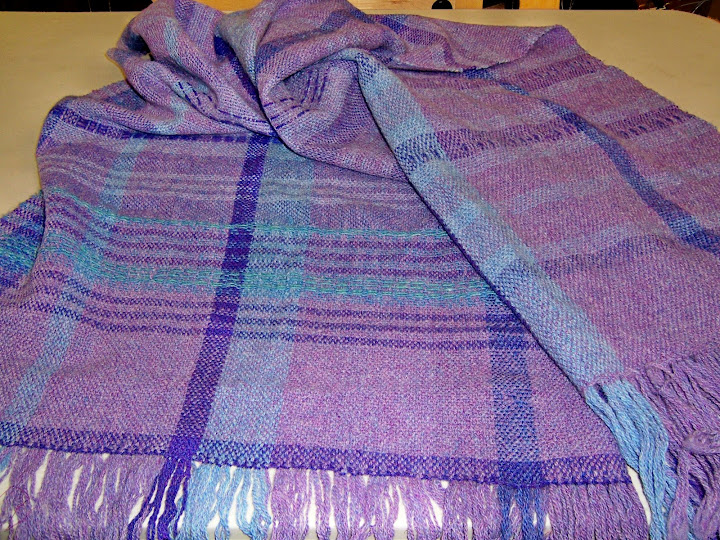

I plan to keep weaving because I love the process, the planning, and the weaving and best of all the finished project. My hope is to master the entire process from sheep to wool, by dyeing the wool, carding it, spinning it, and weaving it. As Syne Mitchell says, "You've got to be warped to weave."3


Pearl Ephraim -

I did pick the ice blue color for my first scarf along with the stitching detail at the bottom because of one of the projects in Liz Gipson's book, "Weaving Made Easy." The garnet was chosen because it was the most attractive color available out of the wools. I liked it so well I used it on two of my three scarves.

As for what I did and didn't like about them: The first scarf, with the large patch of garnet I wasn't crazy about at first because it didn't look like a true plaid to me. It turned out to be asymmetrical with the lavender disappearing amongst the other colors. But it grew on me and became my favorite of the three scarves.

I tried to correct the lack of symmetry in the second scarf. But except for the golden yellow I thought the colors looked dull. You'll notice that they were my original earth tones. I do like the finish work of the knotted fringe at the end.

As for the third and final scarf, I over compensated again trying to get the look of the plaid correctly. The colors are repeated too frequently and the scarf is too busy. I can breathe a sigh of relief that the Easter egg look isn't so prominent any more. They'll grow on me I suppose. I will probably continuing weaving, at least for a while. I'm dying to try a twill.
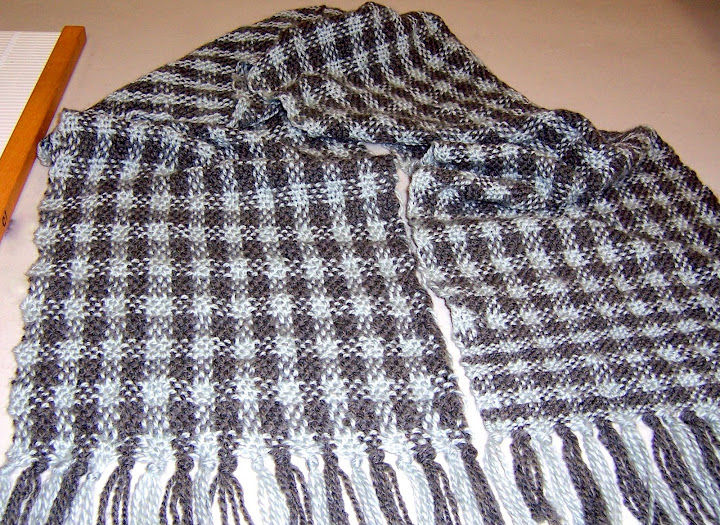

I think I picked the colors (light and dark gray) I did because it seemed they kind of blend in with everything and look cool in every sense. The weaving class was a discovery for me as I never did anything like it before. Now that I have ordered a loom, I am looking forward to doing interesting projects.


Jan Adams -

The course was a great introduction to rigid heddle weaving. I've woven on floor looms, but the rigid heddle is perfect for my small home and it's so portable, too!

The plaid scarf project is something I probably never would have done on my own, so I appreciated the challenge. There were so many wonderful yarn colors to choose from, but I knew I wanted some brown, since I just purchased a brown coat! The blue and yellow complimented it, but jazzed it up, too.
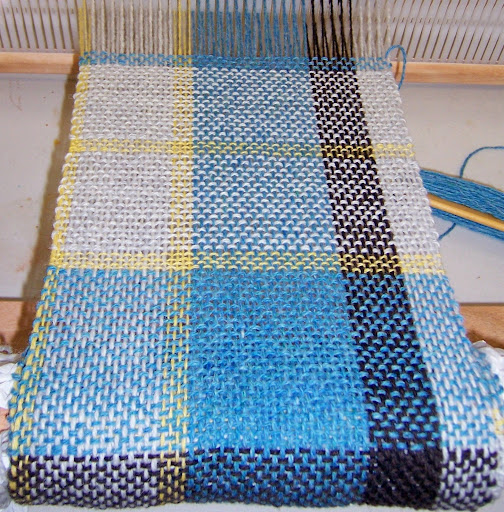

It was especially fun to see the projects selected by the other students, and to confer with them on color choices, etc.
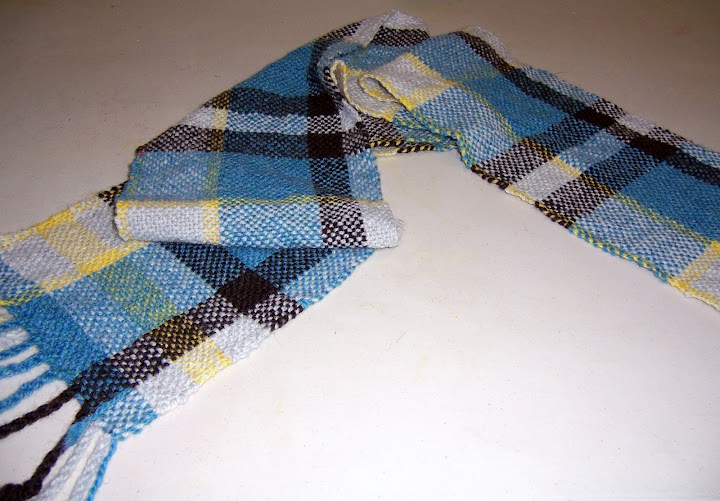

I purchased my own loom and I continue to weave. It is relaxing, creative and fun! There are lots of things one can make on the loom aside from scarves: table runners, placemats, wall hangings, shawls, etc.!


Diana White -

I took the class because I've always wanted to learn to weave. I'm a knitter, and also thought it might be an alternative way to use up some of my stash (or a better excuse to buy more yarn!!). The rigid heddle loom seemed like a manageable way to get started - small, portable loom and not too expensive. Although we spent more time on the tapestry aspect of weaving that I initially was interested in, I'm realizing how much those skills will contribute to future projects, and how frustrated I would have been had we jumped right in to specific projects. Bottom line, I wasn't ready for the scarf project until we got to it, but when we did, I sailed.
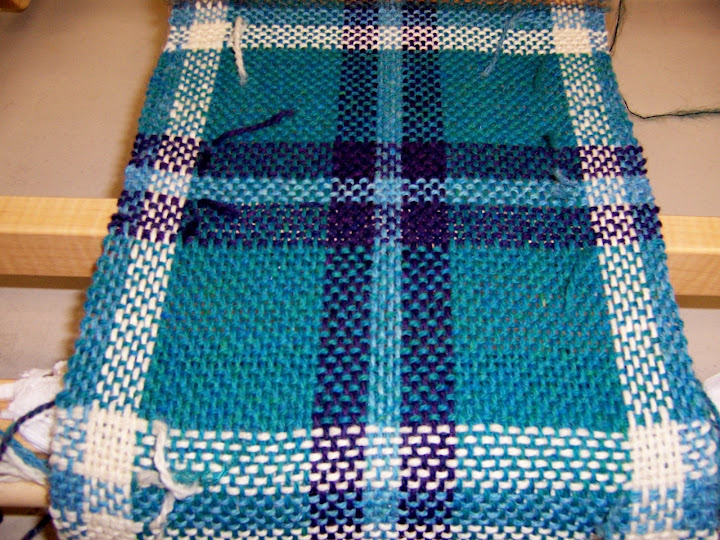

The colors I chose (dark teal, light blue, purple and white) are colors that always appeal to me and I thought worked well together and gave nice contrast. I couldn't be more pleased with the end result. I also think Linda was wise (experienced!) in suggesting we limit the number of colors for a first project. While I may want to expand the selection for future project, four colors provided enough interest, but also helped keep us from a warping nightmare.
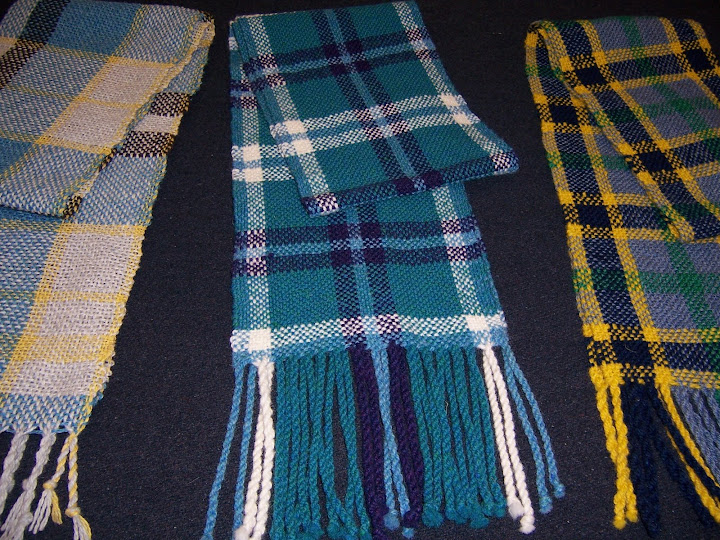

I don't see myself moving to a larger loom any time in the foreseeable future, and I'm looking forward to weaving more scarves, napkins, and placemats on my RH loom. Next fall I plan to take another class to learn how to use two heddles for a fine yarn scarf.


Karen Downs -

I have been knitting for several years and wanted to learn something new. I have been interested in learning to weave for a couple of years. When I signed up for this class I had no idea what a rigid heddle loom was (never even heard of one) and walked into the class with no weaving knowledge at all. I liked learning tapestry weaving. The scarf project was a nice change of pace, balanced weaving is much faster.
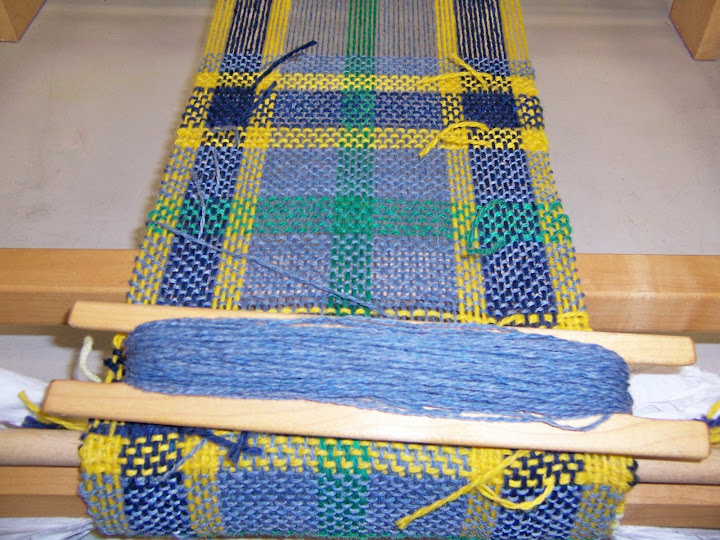

I like my scarf but if I did the same style again, I would switch out the yellow for white or cream. I want to continue with the next class but will wait for the fall project class (maybe something like rag rug placemats). I have been involved in quilting too and have a lot a fabric to use up.
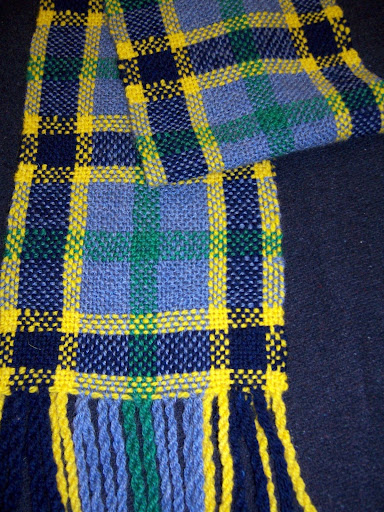


Joanne Qualey -

I loved the scarf project and have so many items in my wardrobe that are red, black or white that I thought a combination of those three colors for my plaid would work for me. I am pleased with the result.
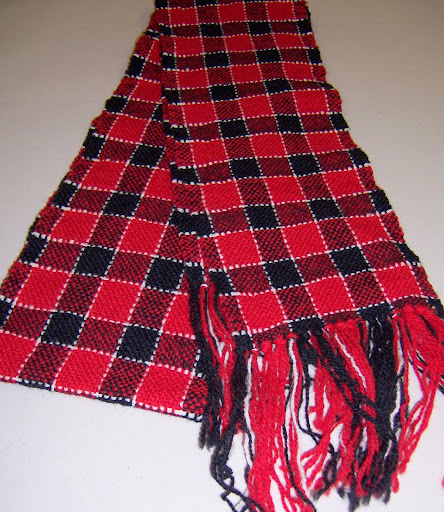

I will be continuing on in the Projects class, and I plan to purchase a rigid heddle loom. I have known for a long time that I wanted to learn weaving and now that my retirement is within reach (probably less than two years away) I want to be sure to have a creative hobby that I can develop more as I have more leisure time. I have always needed to create things to be happy and realize by taking this class that I have stayed away from making things far too long and allowed my work life to become way too all-consuming.


Rosalie Hanlon -

The pattern I chose is a variation of the MacGregor tartan. I chose this pattern because I thought the colours complimented each other well. I am a stickler for symmetry so even when I made a mistake I made sure to copy it on the other end of the scarf too!
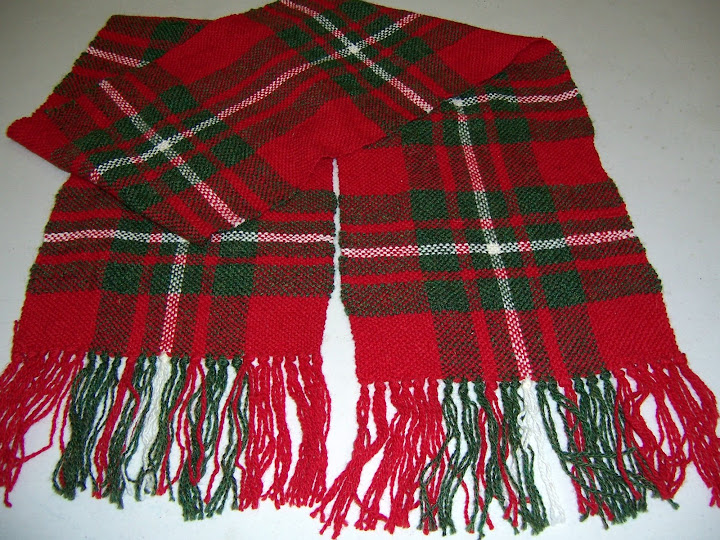

The most difficult part for me was after the scarf was off the loom it was revealed that I had pig-tailed all of my ends instead of weaving them into the scarf. This meant I had to go back and weave them in using a needle, which took a very long time.


Linda Hurt -

Every quarter for about 10 years I’ve been teaching the Basic Weaving class for The Art League. Each class is so completely different that I just keep right on teaching. The people I meet are interesting and come from such varied backgrounds and professions (students, military, opera stars, physicians, house wives, nuclear physicists, retirees looking for a hobby, etc.) that I am always amazed. I continue to learn with each student from their choice of colors, their experiments, and their mishaps. It is probably from their mishaps I learn the most; it relieves me of the responsibility of having to make them all myself.

The plaid scarf project is a favorite of mine, because I get to see color combinations I might not choose. This is where I’ve learned the most valuable lesson: It is good to keep my opinions to myself sometimes and not influence color choices. (I do limit the color number to three or four.) In all of this time, I have not seen a bad combination of colors, and every single plaid has been successful. I am quite proud of these scarves that were created by this very lively and entertaining class. They kept me hopping for nine weeks.


JWD: What did you use for warp and weft?

LH: Harrisville Shetland or Highland weight was used for the student scarves.
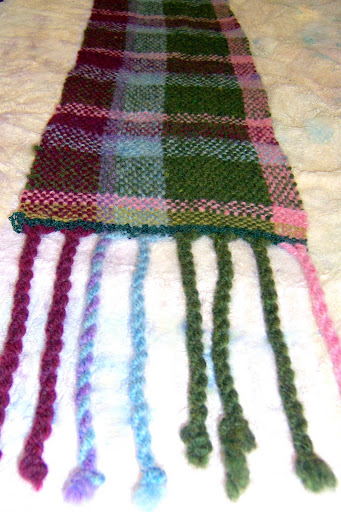
Melissa Burman's scarf after wet finishing. Love these colours!


JWD: How many ends per inch? Picks per inch?


LH: 8 or 10 epi depending on whether Harrisville Highland or Shetland weight was used.

JWD: What structure did you use?

LH: Plain weave was used for the student scarves. It’s appropriate for a first project. Personally, I think I could weave a lifetime and not exhaust its possibilities. (I’ve got a good start on that!) I do enjoy the game of adding heddles and pickup sticks to the mix.

JWD: How long and wide is the scarf?

LH: Most of the scarves were between 60 – 80 inches long. There was one shorter, because the student preferred short scarves. Then there was one that was even shorter, because we forgot to take into account the loom waste. However, it made the cutest and useful warm collar with a button and loop added. I call this “creative recovery.”
[I love that! - jwd]
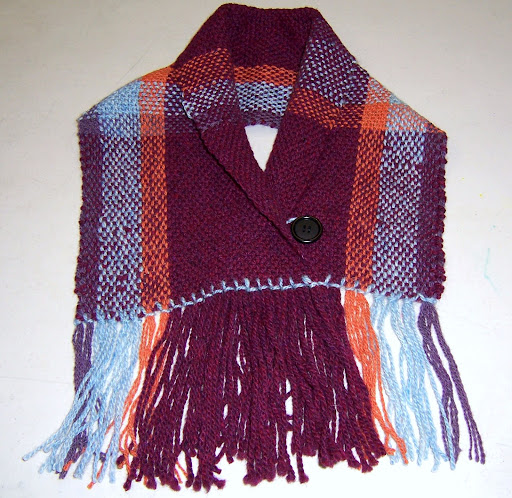
Lenora Stephen's scarf-into-collar. Definitely going to keep this in mind for my own oops-too-short-scarves!

The scarves were between 5 – 12 inches wide. I find that people from the colder climates prefer wider wool scarves than those from warmer climates.

JWD: How did you finish the fringe?

LH: Some people chose to twist the fringe just so they could use my battery operated hair twisters; some tied short fringe because they decided to weave as close to the end as possible; some wanted to learn how to hem stitch; some just preferred the look of one over the other for their particular scarf.
[I have one of those hair twisters. A word to the wise: do not try them in your actual hair. "Ouch" is all I'm gonna say... - jwd]

JWD: What kind of loom did you weave on?

LH: Rigid heddle looms: Schacht traditional; Schacht Flip; Ashford; Beka; Glimakra Emelia

Claudia Loaiza's scarf on the loom. I wonder which type of loom it is?


JWD: How did you warp the loom?


LH: The class uses the “direct warp” technique, which is fast and easy on rigid heddles with short warps. It’s good aerobic exercise walking back and forth too.

JWD: How did you come up with the idea for this scarf?

LH: The original lesson plans I inherited with the job called for weaving a short section of about 6 – 12 inches of a self-designed plaid as a color blending and plain weave exercise. I turned this into a final project, which has been generally popular. I’m flexible. If they don’t want a wool scarf, they can use cotton and make a bread cloth, hand towel, or small table runner.

JWD: Why did you pick the colours/fibres/structure/ design elements?

LH: A plain balanced weave was one of the objectives of this class. Colors were limited to four. Nobody picked my favorite color (chartreuse). Do you suppose they were politely leaving it all for me?

JWD: Is it a present for someone?

LH: So a couple of them said. Then they decided they really liked the scarves themselves. I wonder if they were ever “presented.”

JWD: Were you happy with the project? Would you weave it again?

LH: Everyone in this class was pleased with their scarves. Half of the class made more than one, in fact, one made a whole shawl as one of her pieces.

Claudia Loaiza's scarf after finishing. Look how square her squares are!


JWD: What was your favourite thing about weaving the scarf? Your least favourite?


LH: Most students like the speed at which they can do plain weave as opposed to the tapestry section of the class they had just finished.

JWD: What is your favourite thing about the finished scarf? Your least favourite?

LH: As a teacher, my favorite thing about this project is watching people pick out colors and put them together. I learn a lot here, as many people pick colors that I don’t usually work with. We all have our favorite colors. Some people mix colors I might not, and this broadens my viewpoint on color. I also like to see the smiles as the scarves are finished and people are proud of what they’ve done. Their excitement and pride is my reward.

JWD: Is this scarf like other things you've woven? How is it the same or different?

LH: Generally, I weave for class samples. Many times they’re whole shawls, scarves, table runners, towels, etc. But they are added to my chest of examples.

JWD: Did you do anything unusual (for you, or unusual in general) in this scarf?
LH: These scarves are first weaving projects for most of the class members. They designed the plaids themselves and wove them.


JWD: What do you have on the loom right now, or what's your next planned project?

LH: I have several rigid heddle looms. Though most are empty, I have the following in progress: shawl; heavy twill towel; SAORI banner; tapestry. I also have an overshot table runner on a 4-harness loom. On tablets I have a dog leash, necklace, shoe laces, sample band. On inkles I have a bag for my charkha and an Ikat band.
[And she still finds time to teach and write me this amazing post! - jwd]

JWD: How long have you been weaving?

LH: About 12 years.

JWD: Do you weave other kinds of things? What's your favourite thing to weave? Why?

LH: Samples for classes I teach, because my time is severely limited. As I can eek out time, I’m trying to build up a “trunk” of items that showcase what different kinds of things can be done on rigid heddle looms.

JWD: What's your day job and what impact does it have on your weaving?

LH: Computer programmer, which is not a mere 40-hour a week job. It is more like 60 hours a week, and sometimes more. It often eliminates my time for weaving.
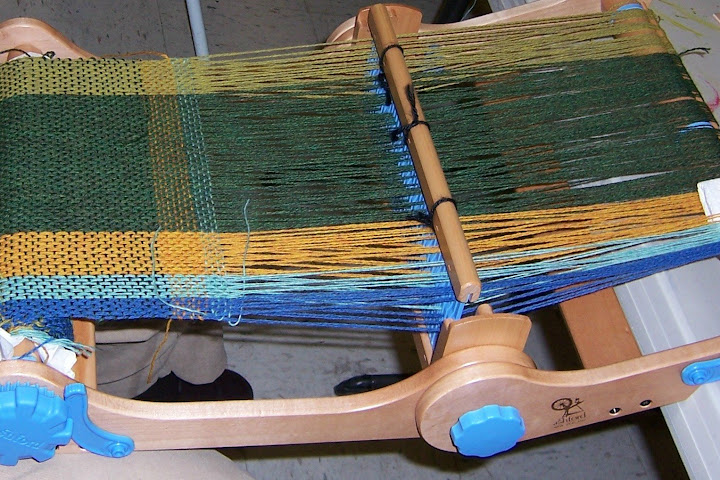
Lenora Stephen's scarf on an Ashford Knitter's Loom. This is the kind of loom I'm getting in two (2) days!

JWD: Do you pursue other fibre crafts such as spinning, knitting, crocheting, felting, quilting, etc etc etc?

LH: Oh, absolutely! Spinning, knitting, crocheting, felting (wet and dry), bobbin lace, lucet, Kumihimo, dyeing, tatting, nålbinding, sprang.
[I don't even know what some of these are! - jwd]

JWD: Do you pursue other handcrafts that aren't fibre related?

LH: I used to, but there is just so little time. Well, sometimes indulge myself and play with beads.

JWD: Do you sell or exhibit your weaving or other handcrafts?

LH: No. I wish I had the time to make enough to be able to sell it and get a monetary return. At present, I have to be satisfied with hording my weavings for class examples.
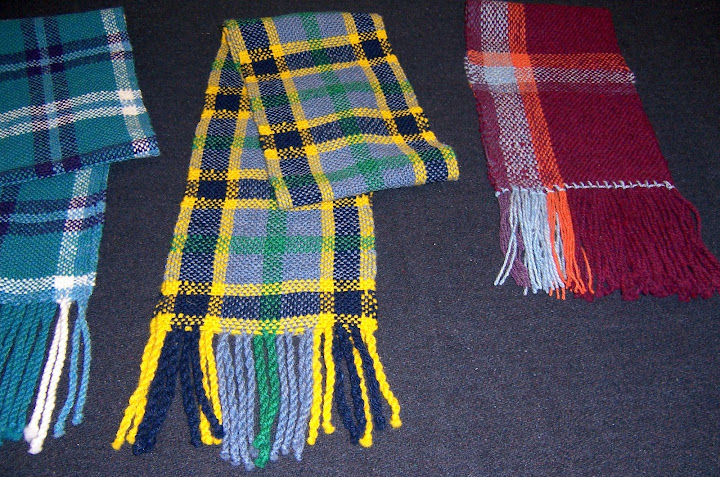


And finally, here are Linda's answers to the much shorter list of questions I actually meant to ask her:
  1. Do you have a blog or other website(s) I can link to?

    No. I wish I had the time to create one and manage it. I keep saying, “Some day.” Teaching fiber arts and working a full-time PLUS job forces me to make choices. Either I weave and maintain a website or I prepare samples, lessons and teach.

  2. What is/are your favourite colour(s)?

    Chartreuse. Orange is my second favorite.

  3. What's your favourite fibre to weave with?

    Wool

  4. What's your favourite dimension (length and width) to weave a scarf?

    72” x 10”

  5. What are the dimensions of your favourite scarf? (the one you wear all the time, handwoven or otherwise)

    72” x 10”

  6. How did you find Scarf A Day?

    Weavezine. Now I check it frequently.

  7. What are 1-5 of your favourite websites and why do you like them? (they don't have to be weaving related!)

    http://www.colorcombo.com/ac.html for web design work
    http://www.tartanweb.org/designer/designer.php an online tartan generator.

    There are several on line tartan generators, and my class enjoyed using them to design their plaids. We used to use graph paper and colored pencils. But these programs are much more fun to use and display results faster. “Faster” is expected in this day and age.


So there you are. Can you see why I was so blown away by all the effort that Linda and her possee of new rigid heddle weavers put into this post? I am SO delighted and SO touched! The guest scarves continue to be right at the top of the list of things I love about Scarf A Day, and this is a perfect example of why.

Linda, thank you! Jan, Melissa, Hannah, Karen, Pearl, Rosalie, Claudia, Kathy, Lenora, Judy, Joanne, and Dianna, thank you. And marvelous job on your scarves, shawls and collars, ladies!

One final related note: as I mentioned in the caption under one of Lenora's scarves, I'm getting an Ashford Knitter's Loom on Friday! Mom has been following along as I've asked for your input into various kinds of rigid heddles and helped me do a little research into the various types... and then, lo and behold, she learned that Donna Kaplan had an AKL that she hadn't ever used and was willing to send to a good home, so Mom nabbed it for me and is bringing it as my birthday pressie. Isn't it amazing how these things work? A couple months ago I had zero (0) interest in rigid heddle weaving but then all these great guest scarves started turning up in my inbox, woven on rigid heddles... then, no sooner do I express an interest in getting one of these babies for myself when a perfect one lands in my lap! And not just any loom, but one previously loved (if slightly neglected) by Donna Kaplan, whose work I just love (and whose workshop I just loved at Convergence 2002). Yay for karma! Yay for mothers! Yay for birthday looms!

You can be 110% sure that I'm taking yarn with me to Halifax and, just as soon as I smooch my dear ol' Mum hello and make sure she's comfy in her hotel room, I'll be warping that loom right in my hotel room. Or hers if she's not too tired!

She's a weaver. I'm pretty sure she'll understand...


1. Albeit on a somewhat smaller scale. Smaller population base around here, doncherknow.

2. I'm not sure which Rigid Heddle Weaving this is. It might be this one, or perhaps this one, or some other book entirely! Judy, can you help me out?

3. This is a reference to Syne's sign-off at the end of every WeaveCast episode. If you aren't already a WeaveCast listener, you should be!

Thursday, March 19, 2009

Better late than never?


Okay, I'll just cut right to the chase: today's scarfa is not only late, it is absent. *Ahem* I do have a moderately good reason for this, however - and, I hope, a reasonably good substitute. And hey, it's still Wednesday somewhere out there, right?
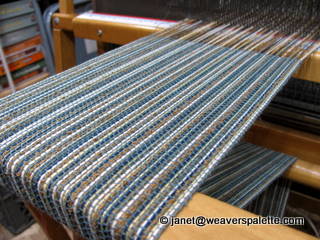
The reason for today's complete lack of scarf are twofold. The first goes back to last week when Beth won the free scarf kit in my first free giveaway. Beth picked her colours right away and I promptly wound her warp and weft. The kit is all boxed and ready for the mail... and yet, I was anxious about sending it. It turns out that Beth warps her loom from front to back, you see, and I honestly wasn't sure how well my warp chains would work from front to back. I wind an inch worth of threads at a time, which works a treat from back to front but I wasn't sure what would happen when an inch worth of threads made their way through the reed and moseyed up to the heddles - I feared that I'd send the kit off to Beth and it would turn into a tangly nightmare on her loom rather than an exciting prize. If anyone was going to be faced with a tangly nightmare on a loom, I wanted it to be me and my loom. And so I decided that I would wind Warp #8 onto the loom from front to back to make sure it works okay and to identify any potential pitfalls and solutions.

Then, since I wanted to write up instructions for warping F2B to send with the kit anyway,1 I thought it would be a peachy idea to take a lot of pictures and even some videos of the process. This would be killing two birds with one stone, I thought: I would both test the process and document it. I should mention at this point that, although I learned F2B first and warped my loom that way for 10 years, when I saw Laura Fry demonstrate her method for warping a loom2 in 2004 I never looked back. I've warped B2F almost exclusively since then - using a slightly modified version of Laura's method - so my F2B skills are Very Rusty Indeed. In retrospect it would have been a good idea to test and refine the F2B process on one warp (or even two!) before documenting the process. As it was, I documented plenty of false starts. ;)

Anyhoo, I now have one (1) warp on the loom and eighty-seven (87) photos and videos of the process I went through to get it there. You may be pleased to learn, as I was, that by far the most difficult part of the process was figuring out where the heck to put the tripod in order to take a video of threading. I confess that dealing with the camera and tripod was a bit sweary but the warp itself wound on as smoothly from front to back as it ever did from back to front. Yay! I am tres relieved!

Yea, I am also Very Tired. Ergo, I shall post a bunch of pics3 so you can see that I did at least work on a scarf today but I am not going to weave a scarf at this hour. I'll try to weave two tomorrow to make up for it. :)

Oh, and a note about the colours in Warp #8. I'd really meant to do the blue/green/brown number I keep talking about but it's not an 8/8 warp like the one Beth chose so it wouldn't have been a good test. I really wanted to use 8/8, which meant I needed to pick some new colours. I was mulling over colours when I remembered a fabulous quilt I saw on Melody Johnson's blog, Fibermania. I ran across Fibermania last week4 and fell madly in love with Melody's hand dyed fabrics - she is all about colour, is Melody, and you know how I eat that up. Yesterday Melody posted a new quilt she'd made and I've gone back to look at it several times; I even commented on how inspiring her use of colour was... and as I remembered this it dawned on me: I could actually use the colours from her fabulous quilt and see if they make a similarly fabulous warp. :)


It's bright, like the quilt, and it makes me happy. :D I really like the warp on the loom - will be interesting to see how it weaves up with some of the other colours from the quilt in the weft.

Without futher ado, here are several of today's pics of warping the loom from front to back (in slightly smaller format than usual so that the page will load is somewhat less than 30 minutes):


I've put quilter's adhesive measuring tape on my beater, measuring from the centre out. Makes it soooo much faster to know where to start sleying!


I use these white erasers all the time to keep my reeds and raddle from sliding around in the beater and in various other ways.


I usually hold the cross in my hand to sley, in which case I tie the warp to the front beam at the choke tie. This pic shows my method of tying the warp on so that it won't slip around...

...I realized, however, that I wanted to preserve my winding cross and that sleying this way would lose it, so I put lease sticks into the cross instead...


...and fastened them to the front beam with the smallest bungy cords known to man: hairbobs! I have tons of these, and use them all the time. People assume this means I have a daughter; really, I just have a barely controlled mess. ;)


The best threading hook EVAR. I also have tons of these, as I am prone to setting them down in odd places and not being able to find them again.


The threads choose their own order for sleying. :)


The first thread being sleyed. The rulers mean I never have to measure where to start.


All the threads sleyed. Imagine a clever video [here] showing how that happened .


The shafts all propped up for ease of threading. I always do this when threading B2F as it's a much better height and easier on my back. Turns out it's better just to leave them down when threading F2B. Who knew?


I [almost always] pull over a threading repeat worth of heddles at a time, and then rarely check my threading after - I am occasionally Saddened by this fact, but I know I've got the right number of heddles on the right shafts before I start, so if I happen to flub up and thread something wrong, I never have to undo more than a single repeat to sort out the heddles and always have the ones I need.


Once I was threaded, I tied the warp onto the beam as usual to provide tension while tying onto the back beam. Turns out it's a really good idea to move the lease sticks up to the beater first since they play havoc with the way the warp spreads if you leave them on the front beam. Guess how I know this?


Tying onto the back beam with surgeon's knots. Look at all that loom waste! B2F, how I miss you! I always tie the outside bouts first to support the rod.


A close up of a surgeon's knot, from a video showing how to tie them, how to tighten them up and how to loosen them again. I never use anything but surgeon's knots. (Except for when I do. Ahem.)


All tied on and ready to go!


Knots are around the beam - time to add paper. Again with the loom waste. Woe is me.


Crankin' and yankin' all at once. Constant tension, as Laura would say. Good thing I've got long arms and a loom with a narrow depth! I actually took vids of winding on this way, and of arranging the warp in a different fashion that lets you put tension on it from behind the loom where you can reach the crank more easily, and of the actual crank and yank method (i.e. without putting tension on the warp while winding). All of them worked just fine even though I'd wound in 1" bouts. O happy day!


D'oh. Forgot to take a pic of the front of the warp once it was all wound on, with the lease sticks still in. Oh well, here's me ready to chop off the end.


And now tying onto the front beam. More surgeon's knots!


All ready to weave! All I need now is eight hours' sleep and I'm all set.

So there you have it. The Cliff notes (Coles' notes, for any Canucks in the crowd) version of F2B warping. Tomorrow we'll see what some weft does with pretty quilty warp, just as soon as I get that scarf kit in the mail...


1. Not that Beth will need them, as you'll see on Friday - the scarves Beth is sharing with us for this week's guest scarf are actually pretty similar in concept, although much finer and more luscious than my simple cotton ones. Mmm Mmm Mmm!

2. If you haven't seen Laura's CD of videos and instructions titled "You Have to be Warped to Weave", you really should! (And I'm not just saying that because I played a small role in its genesis...)

3. The vids are not cooperating. :( For some reason when I chop them down to nice, short, clear snippits, Picasa goes BOOM. Very sad. Also, Google/Blogger wants me to sign some scary user agreement/release form before I can upload videos. Just doesn't seem worth it somehow. At least not at 3:00 aye em.


4. Via Sue's blog, maybe? Ravelry? A Google search of some kind? I can't remember!